
 Arjun Patel
Six hours. That’s what my first encounter with German healthcare cost me, sitting on a plastic chair in a Munich Notaufnahme at eleven at night with a wrist I was fairly sure was broken, watching people who arrived after me get seen before me, understanding none of it.
The wrist was not broken. It was sprained. And the reason I sat there for six hours is that I had gone to the wrong place — I’d used the emergency room as a walk-in clinic, which is what you do in half the world and is precisely wrong here. There is a number, 116117, that would have sorted me out in forty minutes at an out-of-hours practice ten minutes from my flat. Nobody had told me it existed. It had existed for years.
That’s the thing about German healthcare. It’s genuinely good — properly good, top-tier outcomes, and you’re already paying for it whether you use it well or badly. But it is routed. There’s a correct door for every situation, the doors are not intuitive if you grew up somewhere else, and the system assumes you already know which is which. Nobody hands you a map at the airport.
So this is the map. Not “should I take public or private insurance” — that’s a separate decision and a separate article. This is the one after it: you have the card, now what do you actually do when something hurts.
I’m writing this mostly about GKV (statutory insurance), because that’s where the overwhelming majority of employed engineers land. I’ll flag the places where private is meaningfully different, and I promise to be honest about the parts that are genuinely worse here, because there are some and pretending otherwise doesn’t help anyone.
Get a Hausarzt before you need one 🩺
If you take one action from this entire page, take this one, and take it this month rather than the month you get sick.
Your Hausarzt is a GP, but the role is bigger than that word suggests in most countries. They’re your entry point, your referral source, your medical-history holder, your sick-note writer, and — this is the part people miss — your advocate when you need something the system is slow about. A Hausarzt who knows you will phone a specialist colleague and get you seen. A Hausarzt who met you twenty minutes ago will not, because they can’t vouch for you.
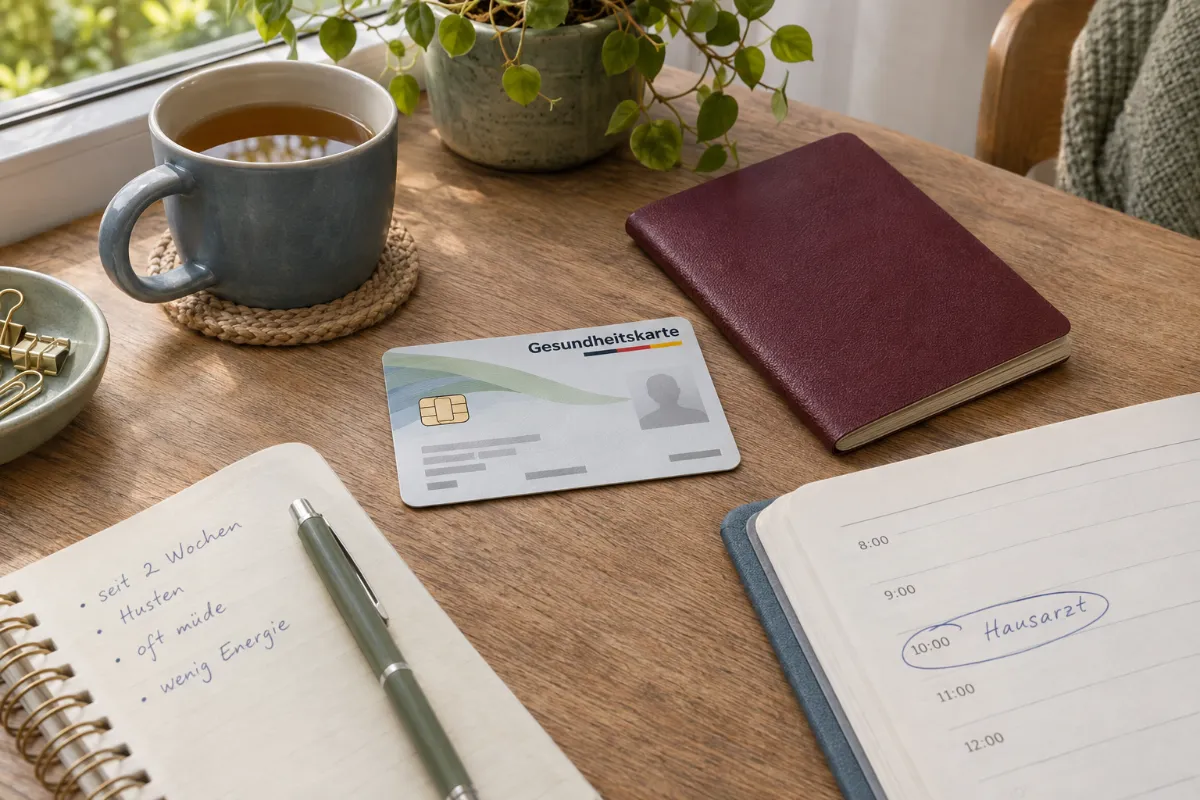
Here’s the trap: the good practices are full, and they close their lists. You cannot decide on a Tuesday that you’d like a Hausarzt and have one by Friday. In Berlin and Munich in particular, a lot of practices simply aren’t taking new patients — the phrase you’ll meet on their door or answerphone is “wir nehmen derzeit keine neuen Patienten auf”, “we are not currently accepting new patients” — and the ones that are will book your first appointment six weeks out. So the correct time to register is when you’re perfectly healthy and it feels pointless.
How to actually find one:
- Your Krankenkasse (your health insurance fund, the organisation whose card is in your wallet) has a search tool and a phone line, and honestly the phone line is better. Say you’re new, ask which practices in your Bezirk (district) are accepting; they know.
- The Kassenärztliche Vereinigung, the regional association that all statutory-insurance doctors belong to, publishes a directory for each state. It’s ugly, it works.
- Filter for English if you need to, but read the next paragraph first.
- Ask your colleagues. Every office has someone who’s been here eight years and has A Guy.
On language: in Berlin, Munich, Hamburg, Frankfurt and Cologne you can find English-speaking doctors without much trouble, especially younger ones. Outside the big cities it gets thin fast. And a slightly uncomfortable truth — restricting yourself to English-speaking practices shrinks your pool at exactly the moment the pool is already too small. If your German is decent-ish — and it matters more at the doctor’s than at work — a German-speaking practice near your flat will often serve you better than an English-speaking one across town. Medical German is a small, learnable vocabulary. Write your symptoms down beforehand and bring the paper; I did this for a year and nobody minded.
This week: register with a Hausarzt. Bring your health card, your passport, and about twenty minutes for the intake form. That’s it. That’s the whole task, and it’s the difference between “I’ll get you in tomorrow” and “call 116117” for the next several years.
The three numbers, and which one you actually want ☎️
This is the table I wish someone had put in front of me before the wrist incident.
| Situation | Where you go | What it is |
|---|---|---|
| Life-threatening. Chest pain, stroke signs, severe bleeding, unconscious, serious accident | 112 | Emergency services. Ambulance and fire. Free, no hesitation, never apologise for calling |
| It’s 9pm / Sunday / a holiday, you need a doctor, but you’re not dying | 116117 | The out-of-hours on-call medical service. 24/7, free. They’ll direct you to a Bereitschaftspraxis (an on-call practice that opens when normal surgeries are shut) or send a doctor to you. This is the one nobody knows about |
| Genuine emergency but you can get yourself there | Notaufnahme | Hospital A&E. Correct for real emergencies. Wrong, slow and resented for anything else |
| Normal illness, normal hours | Your Hausarzt | Most practices hold walk-in Akutsprechstunde slots in the morning. Call at 08:00 |
| You need a specialist and the wait is absurd | 116117, again | Different service, same number — see below. Very few people use this |
The mental model that makes it click: 112 is for when minutes matter. 116117 is for when hours matter. Your Hausarzt is for when days matter. Notaufnahme is not a category, it’s a destination for the first one.
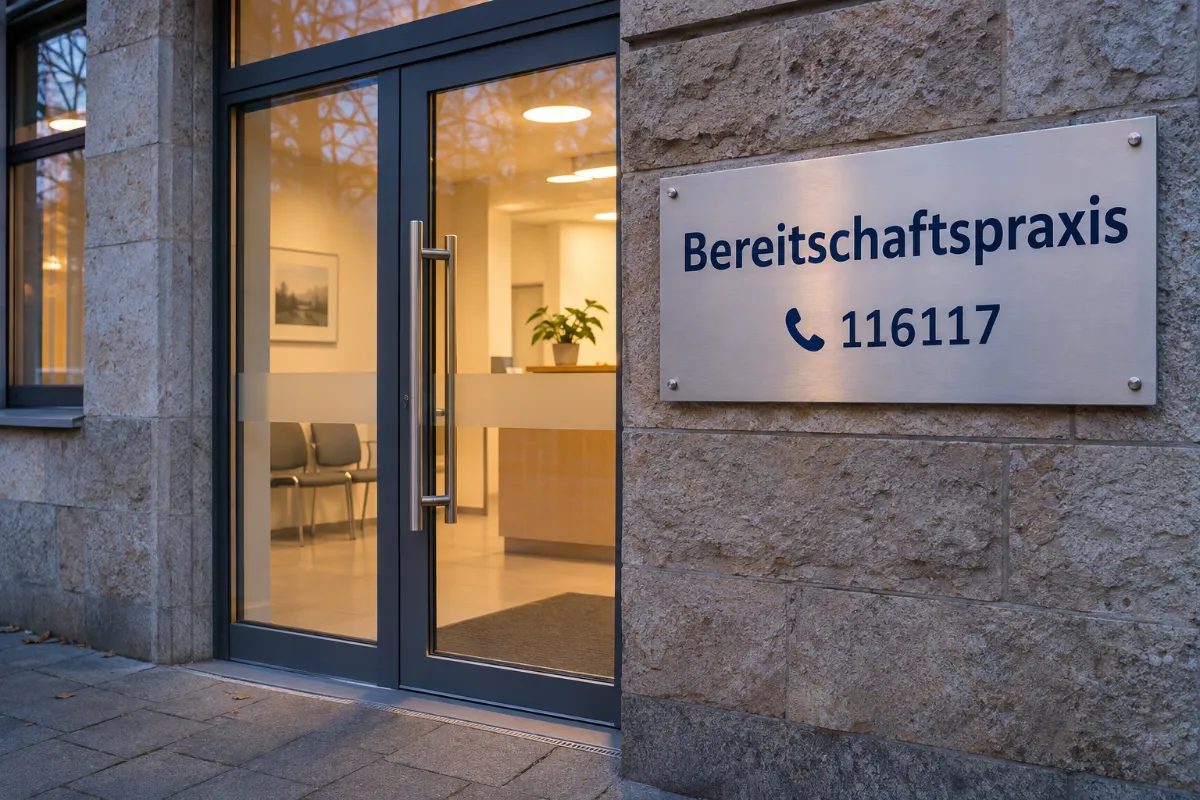
And one genuinely important cultural note: turning up at a Notaufnahme with a non-emergency isn’t just inefficient, it’s read as a small social violation. You’ll be triaged to the back and you will feel the disapproval. It’s not personal. The system has one door for emergencies and it’s protective of it.
The four-week guarantee almost nobody uses 🎟️
Right. This is the single most useful thing in this article, and I’d guess nine out of ten foreign residents don’t know it exists.
You need a dermatologist. You call around. Best offer is March, it’s currently September. Standard German specialist experience, and most people just… accept it, and complain about it, and wait six months.
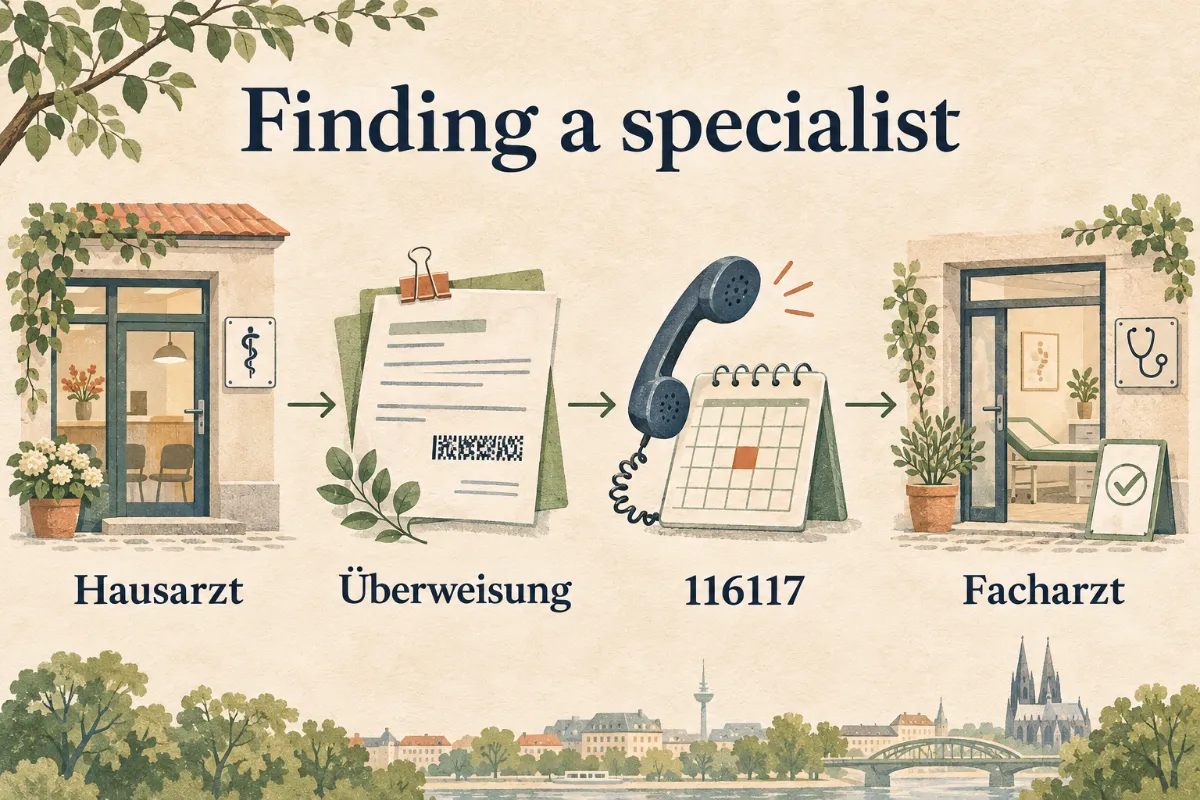
You don’t have to. There’s a Terminservicestelle (appointment service) run through that same 116117 number, and it is legally obliged to find you a Facharzt (specialist) appointment within four weeks. Not the doctor of your choosing, not necessarily near your flat, but a qualified specialist within four weeks instead of six months.
How to use it:
- Get an Überweisung (referral) from your Hausarzt. For the appointment service you need one carrying a twelve-digit Vermittlungscode — ask for it explicitly, by name, because it’s a specific thing the practice generates and they won’t add it if you don’t ask.
- Call 116117 or use the online booking service.
- Give them the code. They find the slot. Four weeks, maximum.
This isn’t a courtesy, by the way, it’s a statutory duty: §75 Abs. 1a SGB V says in as many words that “die Wartezeit auf einen Behandlungstermin darf vier Wochen nicht überschreiten”. Worth knowing the sentence exists if someone on the phone tells you otherwise.
Caveats, because I want this to be accurate rather than exciting: routine and minor check-ups are excluded from the guarantee — this is for things with an actual medical reason behind them. You take the appointment you’re offered, and it might be across the city. Two deadlines are shorter than four weeks: radiology is three, and psychotherapeutic acute treatment is two, which matters and I’ll come back to it.
That’s it. That’s the trick. It has been sitting there the whole time.
Überweisung, and how referrals actually work 📋
The formal position in GKV is that you have free choice of doctor and don’t strictly need a referral for most specialists. The practical position is that you should get one anyway, basically always.
Because: a lot of practices will simply refuse you without one, some specialties (radiology, labs) genuinely require one, the Terminservicestelle needs it, and — the real reason — an Überweisung carries your Hausarzt’s read of the problem. “Please assess this mole” gets a different appointment than a stranger phoning up asking for a dermatologist.
An Überweisung is valid for the quarter it’s issued in, which is a small trap: get one in late March and it may expire before you’ve used it. Ask.
Some Krankenkassen also run a Hausarztzentrierte Versorgung programme, where you formally commit to going through your Hausarzt first in exchange for perks. Usually a reasonable deal, but read what you’re signing up for — it does restrict you.
Two more things nobody tells you. There is no annual physical here. The American yearly-checkup ritual isn’t the culture; there’s a Check-up 35 health screening from age 35, and cancer screenings on their own schedules, and otherwise you’re expected to show up when something’s wrong. Nothing is broken, it’s just different, and if you want a baseline you can ask. And the Praxisgebühr — the €10-per-quarter charge — was abolished in 2013, so if anyone tells you to pay it, they’re a decade out of date.
Mental health: the honest section 🧠
I’m not going to soften this. Psychotherapy is the weakest part of an otherwise excellent system, and if you arrive needing it, you’re going to hit a wall.
The therapy itself, once you’re in, is good, and it’s covered — a full course of Richtlinientherapie runs to dozens of sessions and the insurance pays. That’s better than most countries manage. The problem is purely getting in. Waits for a regular therapy place commonly run three to six months, sometimes longer, and it varies enormously by city — one more factor worth weighing when you pick where to live — and by whether you can do sessions in German.
The route through, in the order it actually works:
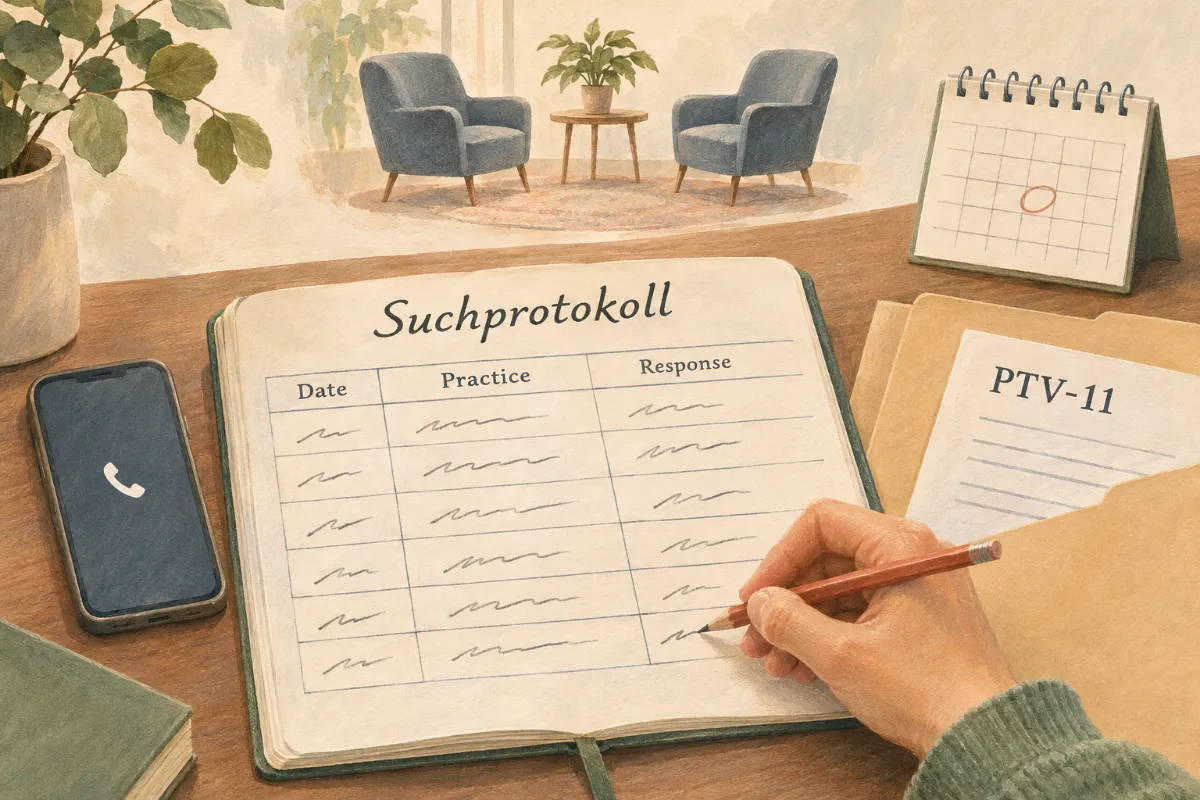
Step 1 — Psychotherapeutische Sprechstunde. An initial consultation with a licensed therapist. It is not therapy; it’s an assessment that produces a form (the PTV-11) recording what you need. You want this on paper early, because everything downstream depends on it. Book via 116117 or by calling practices directly.
Step 2 — Akutbehandlung, if it’s urgent. Short-notice crisis sessions, and the appointment service is held to a two-week deadline for these rather than four. If you’re in a bad place, say the word Akutbehandlung explicitly when you call. It changes the queue you’re in.
Step 3 — Richtlinientherapie. The actual course of therapy. This is where the months of waiting live.
And the step nobody mentions: Kostenerstattungsverfahren, the cost-reimbursement route. This is the real unlock, so read it properly. Under §13 Abs. 3 SGB V, if your statutory insurance genuinely cannot provide you a therapy place within a reasonable time (usually read as around three months), that’s a Systemversagen, a system failure, and you can go to a private therapist and have your Kasse reimburse it.
It is not automatic and it is not quick, but it’s a real legal right and it works. What you need:
- A Suchprotokoll — a search log. Every practice you called, the date, and what they said. Ten to fifteen documented rejections is the sort of evidence that gets taken seriously. Keep it in a spreadsheet from your very first call, because reconstructing it later is miserable.
- Ideally the PTV-11 from a Sprechstunde at a statutory-registered practice, confirming you need treatment.
- A private therapist willing to bill this way — many are, ask directly.
- A written application to your Kasse.
Each Krankenkasse sets its own criteria and decides case by case, so outcomes vary and a first rejection is not the end — appeals succeed regularly. If you’re getting nowhere, the Psychotherapeutenkammer for your state can advise, and it’s free.
The thing I’d say to anyone in this position: start the paperwork on day one, not month four. The Suchprotokoll only works if it was built while you were searching. I’ve watched someone lose four months because they didn’t start writing the calls down.
The pharmacy will surprise you 💊
You will, at some point, walk into a REWE with a headache looking for ibuprofen, and you will not find it, and you’ll assume you’re in the wrong aisle. You’re in the wrong shop.
German medicines come in three tiers and the middle one is the one that catches everybody:
| Tier | Where | Examples |
|---|---|---|
| Freiverkäuflich | Supermarket, Drogerie (dm, Rossmann) | Vitamins, herbal teas, some mild cold remedies |
| Apothekenpflichtig | Pharmacy only — but no prescription needed | Ibuprofen 400mg, paracetamol, aspirin, most of what you think of as OTC |
| Verschreibungspflichtig | Pharmacy, prescription required | Ibuprofen 600mg and up, antibiotics, most everything else |
So the common expat complaint, “you need a prescription for painkillers in Germany”, is wrong. Worth being precise about, because the wrong version makes people book pointless doctor appointments. You don’t need a prescription for ibuprofen 400. You need to walk into an Apotheke and ask the person behind the counter for it. Same day, no appointment, two euros.
The rest of the pharmacy rules:
- It’s closed on Sunday, like everything. But there’s always an emergency pharmacy on rotation, the Apothekennotdienst, and every pharmacy’s door has a sign showing which one is on duty tonight. Also findable by phone and online.
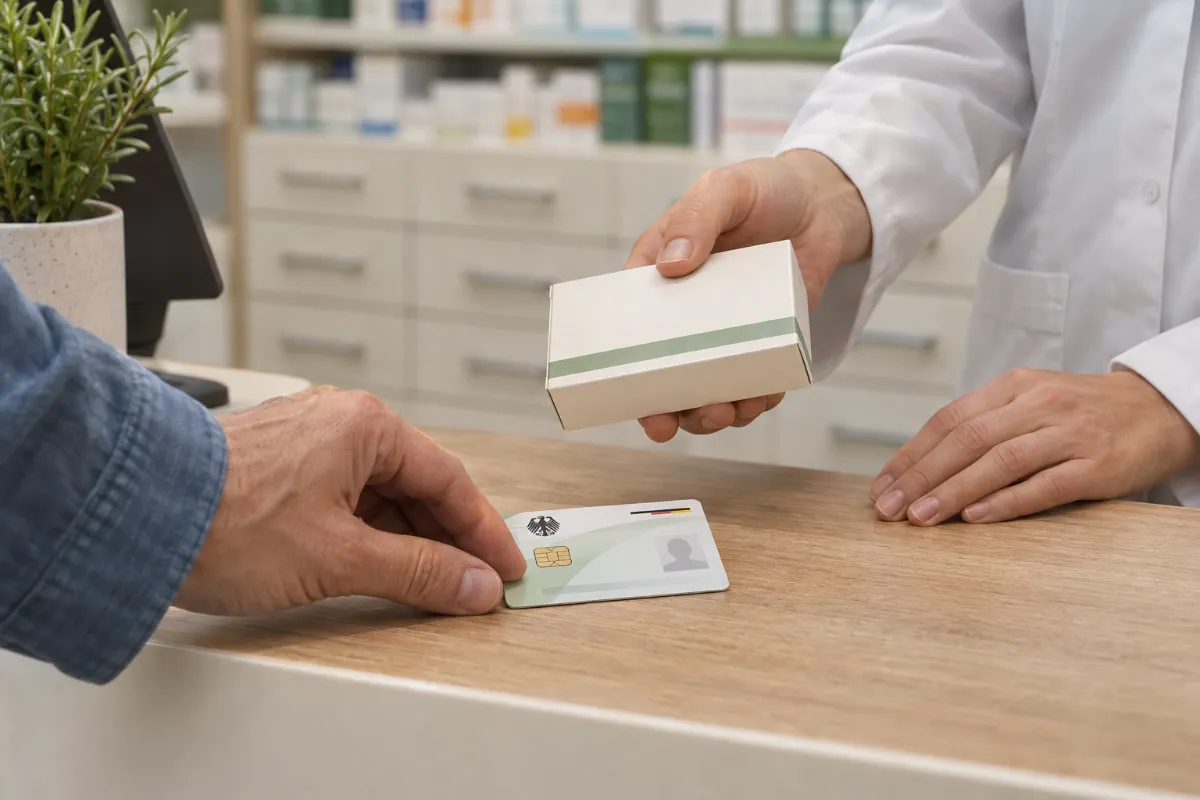
- Prescriptions are electronic now. The E-Rezept lives on your health card: your doctor sends it, you tap your card at the pharmacy. No paper to lose. If you’re used to carrying a slip around, you’ll keep patting your pockets for a month.
- You pay a small co-pay on prescriptions, typically €5–10 per item, capped annually. Not the American experience.
- Pharmacists here are genuinely consulted. They have real training and real authority and they’ll spend ten minutes with you. Use them — for a lot of minor things, the Apotheke is the correct first stop and it replaces a doctor’s visit entirely.
The dentist is a separate country, and the booklet is real 🦷
Dental works differently enough from the rest of the system that treating it as “just another specialist” costs people money.
You don’t need a referral — book a Zahnarzt directly, and unlike with most specialists you can usually get in within a few weeks. Routine check-ups and basic treatment are covered. Where it diverges sharply is anything approaching Zahnersatz — crowns, bridges, implants, dentures. There, your insurance pays a Festzuschuss, a fixed subsidy pegged to a standard-care benchmark, and you pay the rest. On an expensive crown “the rest” can be four figures.
Which brings us to the Bonusheft, and this is the actionable bit. It’s a small paper booklet your dentist stamps once a year when you turn up for a check-up. Keep it filled in without gaps and the subsidy rises — the tiers are set in §55 SGB V, so they’re the same whichever Krankenkasse you’re with:
| Bonusheft record | Your insurance pays |
|---|---|
| No booklet / gaps | 60% of the standard-care benchmark |
| 5 unbroken years | 70% |
| 10 unbroken years | 75% |
One missed year resets you. So a fifteen-minute check-up you skip in 2026 can cost you several hundred euros on a crown in 2031, and there is no way to retroactively fix it.
Ask for a Bonusheft at your very first dental appointment in Germany. They won’t necessarily offer it — the German patients all have one already and nobody thinks to mention it. This is the single highest return-on-effort item in this entire article: one appointment a year, one stamp, and you’re on the better rate for life.
The dentist is enough of a separate country to need its own map — what GKV actually covers, the full Festzuschuss and Bonusheft mechanics, implants, braces and when a supplement is worth it are all in the German dentistry guide.
Sick notes, and a myth worth killing 🤒
The rule people repeat is “you need a doctor’s note from day three.” The rule is actually: your employer can require one from day one, and by default the legal threshold is after three calendar days. Check your own contract, because plenty of German employers do specify day one, and finding that out on day two is a bad way to find it out.
Mechanically it’s electronic now — the eAU. The doctor transmits it, your employer’s payroll pulls it, and you no longer post a yellow slip. You still have to tell your employer you’re sick, immediately, on the first morning. That obligation didn’t go anywhere, and it’s the bit people actually get in trouble for.
Two things worth knowing because they’re better than you’d expect.
First, you get full salary for up to six weeks of a single illness — Entgeltfortzahlung, under §3 EFZG. After those six weeks the Krankenkasse takes over with Krankengeld, which is roughly 70% of your gross but capped at 90% of your net, and it can run for up to 78 weeks within a three-year period for the same condition. Which means a serious illness here does not end your income. That’s worth knowing before you need it, because it’s a very different backdrop from a country where six weeks off means six weeks unpaid.
Second, you get Kinderkrankentage — paid days to care for a sick child, separate from your own sick leave and separate from your holiday. Parents routinely don’t know about this one and burn annual leave instead.
Also, being off sick is not treated as a moral failing here. Nobody expects you to answer Slack. Genuinely, nobody. The first time a German colleague tells you to close your laptop, they mean it.
What about private insurance, and gaps? 🏷️
Briefly, because it’s a different article: on PKV (private Krankenversicherung, private health insurance — the alternative to GKV, open to you above a certain income — the threshold and the long-term trade-off are in the GKV vs PKV section of the net salary guide) you generally get specialist appointments faster and see a different queue, you pay up front and claim back, and the Hausarzt-first routing is optional rather than expected. The 116117 emergency service works identically for you. Health cover is only one policy among several, though — which insurance you actually need in Germany sorts the genuine essentials (liability, disability) from the ones to skip.
And one gap worth naming, since it catches people at exactly the wrong moment: if you lose your job, your health insurance continues — the employment agency takes over your contributions while you’re on Arbeitslosengeld. You do not go uninsured, and you must not let a gap open, because reinstatement is far more painful than continuity. That’s covered properly in what actually happens when you lose your job on a Blue Card. If you’re going freelance, the picture changes a lot more and the freelancing guide has that.
The short version
- Register with a Hausarzt now, while you’re healthy. Everything else gets easier.
- 112 for life-threatening, 116117 for out-of-hours, Hausarzt for everything else. Notaufnahme is not a walk-in clinic. Learn from my wrist.
- Specialist wait is absurd? 116117 again — Überweisung with the twelve-digit code, four-week guarantee.
- Therapy: start the Suchprotokoll on day one. §13 Abs. 3 is real, and it only works with evidence you collected while you were still searching.
- Ibuprofen is at the Apotheke, not REWE, and you don’t need a prescription for it.
- Ask your dentist for a Bonusheft at your first appointment, then never miss a year. It’s fifteen minutes annually against hundreds of euros later.
- Tell your employer the first morning. Check whether your contract wants a note from day one.
Once you know the routing, it’s a very good system — and you’re already paying about 7.3% of your gross plus the Zusatzbeitrag for it, which you can model with the salary calculator or compare against typical pay on the salary pages. You may as well get your money’s worth. Registering with a Hausarzt is also on the first 90 days checklist, along with the rest of the arrival admin — and it’s the item on that list people most often skip, because nothing hurts yet.
Six hours on a plastic chair. Don’t be me.
This is a navigation guide written by an engineer who’s used the system, not medical advice. For anything urgent call 112. Insurance rules and co-pays change, Krankenkassen set their own criteria for reimbursement cases, and practice varies by state.