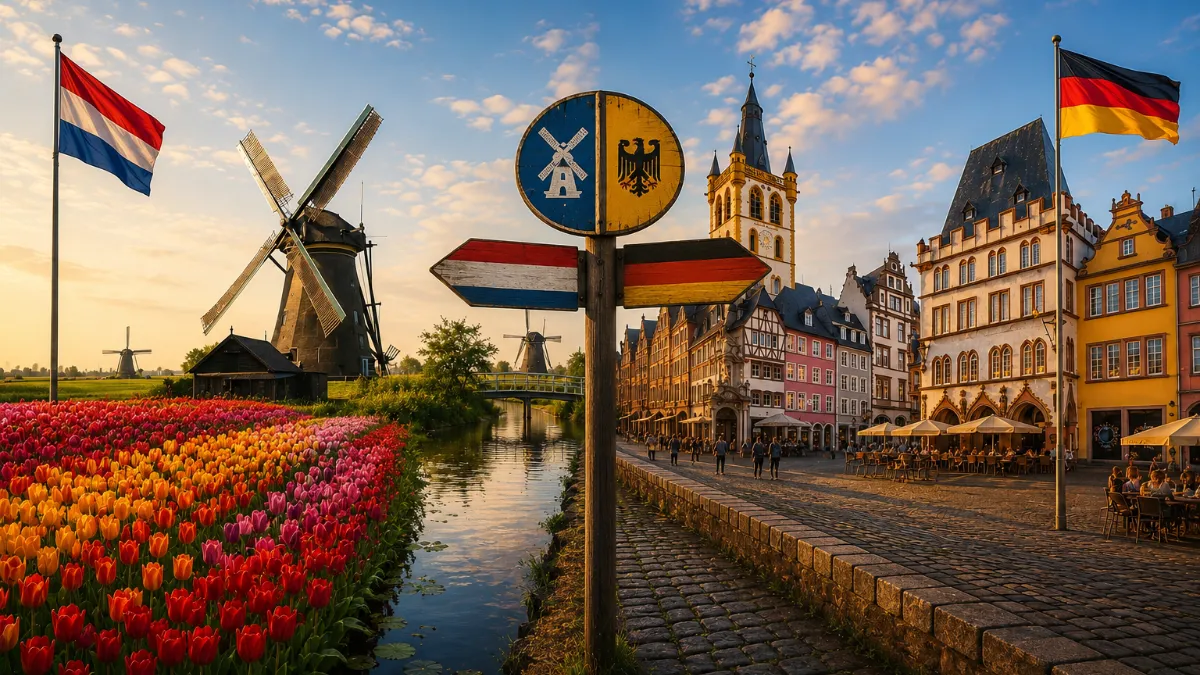
 Arjun Patel
Germany vs the Netherlands for Tech Workers in 2026 — I Lived in Both, Here’s the Honest Version 🇳🇱🇩🇪
Quick story before the numbers. I came to Amsterdam in 2019 for a backend job, stayed almost five years on the famous Dutch 30% ruling, and then start of 2024 my wife and me packed everything into one van and moved to Munich. So when people ask me on LinkedIn “Netherlands or Germany?”, I don’t answer from a spreadsheet only. I answer from two tax returns, two awful flat searches, and two very different town-hall experiences. 😅
For about twenty years the 30% ruling was the single biggest reason foreign tech people picked Amsterdam over Berlin, Munich or Frankfurt. That era is closing now. From 1 January 2027 the ruling is permanently cut to a flat 27%, and its minimum-salary bar goes up again. Germany, in the meantime, opened its EU Blue Card to IT specialists without a degree, cut the time to permanent residence roughly in half, and the top Berlin/Munich offers now reach money I honestly never saw in the Netherlands.
So the maths moved. This is more or less the comparison I wish somebody had given me in 2019 — take-home pay, visa thresholds, cost of living, salaries and startup depth — but with my own notes from actually doing the move.
In a hurry? Run your own German figure in our net-salary calculator and check what you qualify for with the visa checker. If you already decided for Germany, my 6-month relocation playbook takes you from job hunt to Anmeldung — and my first 90 days checklist takes it from there, through the Steuer-ID, bank, Krankenkasse and eAT marathon.
The 30% ruling in 2026 — and what bites in 2027
I will be honest: the 30% ruling is the thing I miss most. Seeing 30% of your gross land in your account tax-free, every month, for up to five years — it spoils you. For 2026 it’s still a flat 30% tax-free. The “30/20/10” taper that was floated in the 2024 Tax Plan got scrapped, so anyone who started using the ruling in 2024, 2025 or 2026 keeps the full 30% through all of 2026 (Business.gov.nl, Government.nl).
Confirmed 2026 parameters:
- Tax-free percentage: 30% in 2026; 27% from 1 January 2027 (this hits existing rulings too, not only new ones).
- Minimum taxable salary (2026): €48,013 standard; €36,497 for under-30s with a recognised master’s. From 2027 the standard threshold rises again to €50,436.
- Income cap (“Balkenende norm”): €246,000 in 2026 — no tax-free part above that ceiling; transitional relief ended 31 December 2025.
- Partial non-resident status (Box 2/3): abolished from 1 January 2025; last transitional users ended 31 December 2026.
- Duration: still a maximum of 5 years.
The takeaway: the Netherlands is still generous in 2026, but the headline benefit is shrinking on a known schedule — and the salary bar keeps climbing. One small warning from my own paperwork: the ruling is for five years total, and any earlier time you spent in the Netherlands can eat into it. Read your grant letter carefully, the start date is not always what you think.
Take-home pay: €85,000 and €120,000 gross, five scenarios 💶
All figures use 2026 tax parameters. The Dutch side uses Box 1 brackets of 35.75% up to €38,883, 37.56% up to €78,426 and 49.50% above, with general and labour tax credits. The German side uses the 2026 Grundfreibetrag of €12,348, the progressive schedule up to 42% (45% above €277,826), plus 2026 social contributions — pension 18.6%, unemployment 2.6%, health 14.6% + ~2.9% supplement, long-term care 3.6% (4.2% childless), with the health/care ceiling at €69,750 and the pension/unemployment ceiling at €101,400. Figures are indicative, rounded to the nearest €100, single and childless, without church tax and solidarity surcharge.
Want an exact German number for your own salary, tax class and city? Use our German net-salary calculator — it’s free and updated for 2026.
€85,000 gross per year
| Scenario | Approx. annual net | Approx. monthly net |
|---|---|---|
| NL — 30% ruling (2026) | €58,500–€59,500 | €4,850–€4,950 |
| NL — 27% ruling (from 2027) | ~€57,000–€58,000 | ~€4,750–€4,830 |
| NL — no ruling, standard tax | ~€51,500–€52,500 | ~€4,290–€4,375 |
| DE — Tax Class I (single) | ~€50,000–€51,500 | ~€4,170–€4,290 |
| DE — Tax Class III (married, sole earner) | ~€57,500–€59,000 | ~€4,790–€4,910 |
€120,000 gross per year
| Scenario | Approx. annual net | Approx. monthly net |
|---|---|---|
| NL — 30% ruling (2026) | €78,000–€79,500 | €6,500–€6,625 |
| NL — 27% ruling (from 2027) | ~€75,500–€77,000 | ~€6,290–€6,420 |
| NL — no ruling, standard tax | ~€66,500–€68,000 | ~€5,540–€5,665 |
| DE — Tax Class I (single) | ~€65,500–€67,000 | ~€5,460–€5,585 |
| DE — Tax Class III (married, sole earner) | ~€75,500–€77,500 | ~€6,290–€6,460 |
What the numbers say, and what I actually felt. On €120,000, the 2026 Dutch 30% ruling is worth roughly €12,000–€14,000 of extra net per year versus German Tax Class I. That gap is real and you feel it. Once the ruling steps down to 27% in 2027 it narrows to about €9,000–€11,000. And here is the part that surprised me when I moved: a German married sole-earner in Class III (Ehegattensplitting) roughly matches a Dutch earner on the post-2027 ruling. My wife wasn’t working for the first months in Munich while she job-hunted, and that Class III split softened the landing a lot — the Netherlands has no joint filing, so we would never have got that there.
Strip the ruling out completely and the two countries are close. The Netherlands edges ahead up to around €80,000 gross, then Germany pulls level or slightly ahead, because the Dutch 49.5% top bracket starts already at €78,426 while Germany holds 42% all the way to €277,826. For the full German picture by level and city, see what software developers actually take home in Germany and the €60,000 reality check.
Visa and immigration thresholds for 2026 🛂
Netherlands — Highly Skilled Migrant (Kennismigrant)
This was my route, so a small but important lesson is coming a few paragraphs below. The IND’s 2026 minimum gross monthly salaries (excluding the 8% holiday allowance), effective 1 January 2026 (IND):
- Highly Skilled Migrant / ICT, age 30+: €5,942/month (≈ €71,304/year ex. holiday pay)
- Highly Skilled Migrant / ICT, under 30: €4,357/month
- Reduced rate (recent graduate / orientation year): €3,122/month
- EU Blue Card (Netherlands): €5,942/month
- Reduced EU Blue Card (graduates within 3 years): €4,754/month
From 1 January 2026, recognised sponsors also have to keep bank statements proving the salary was actually paid — payslips alone don’t satisfy an IND audit anymore.
Germany — EU Blue Card
Confirmed by the Federal Ministry of the Interior for 2026 (Make it in Germany):
- General occupations: €50,700 gross/year (≈ €4,225/month) — up from €48,300 in 2025
- Shortage occupations, recent graduates, IT specialists without a degree: €45,934.20 gross/year (≈ €3,827.85/month) — up from €43,760 in 2025
The thresholds are pegged at 50% and 45.3% of the pension-insurance ceiling (€101,400 in 2026). The big one: under the reformed Skilled Immigration Act, IT specialists with three years of relevant experience in the last seven can qualify without a university degree, on the reduced threshold. The Netherlands has nothing like this. We cover the no-degree route, the documents and the processing times in the EU Blue Card Germany 2026 guide.
Not sure which route fits you? Our visa checker screens you against the 2026 German thresholds in under a minute.
DAFT — Dutch-American Friendship Treaty (US citizens)
DAFT is a 1956 treaty that gives US citizens a privileged self-employment route into Dutch residency. It does not cover salaried jobs — it’s an entrepreneur permit, used to freelance, consult or run a Dutch BV. 2026 requirements:
- US citizenship and a valid passport
- Minimum €4,500 held in a Dutch business bank account through the whole permit
- At least 25% ownership of the Dutch business
- IND application fee around €420 for the main applicant
- Initial permit: 2 years, renewable; permanent residence possible after 5 continuous years
- No language or minimum-income requirement, no labour-market test, no degree
- Spouse/partner and minor children get dependent permits, and the spouse has full labour-market access — so a US freelancer’s partner can take any Dutch salaried job
Since early 2026 the IND started retroactively auditing DAFT holders to check the business activity is genuine and continuous, so keep clean books. Germany has no DAFT equivalent for Americans; the closest is the freelance/self-employment residence permit, which is discretionary and very document-heavy.
Partner and spouse work rights
- Netherlands (HSM / Blue Card): the partner gets a dependent permit with unrestricted labour-market access from day one.
- Germany (EU Blue Card): the spouse gets a residence title “without requiring knowledge of German” and “immediate and unlimited permission to take up employment”, per BAMF.
Both countries are equal here. My wife could work in both, day one, no extra paperwork. That mattered a lot to us.
Path to permanent residence
- Netherlands: 5 continuous years on a valid permit, plus the civic-integration exam (A2), stable income and BRP registration. No faster track for HSM or Blue Card holders.
- Germany (EU Blue Card): 21 months with B1 German, or 27 months with A1, plus the “Living in Germany” test (BAMF).
Germany is by far the faster settlement route — roughly half the Dutch timeline — if you’re willing to reach B1 German. I’m grinding through my B1 now exactly for this. And the clock after that is short too: the 2024 reform put citizenship in reach in five years, which we map out in Blue Card to German citizenship.
EU Blue Card intra-EU mobility (Directive 2021/1883)
Okay, here is the lesson I promised. I was on the Dutch HSM permit, not the Blue Card. When I moved to Germany I assumed my Dutch time would just carry over. It does not. I had to do a completely fresh German application. If I could start again, I would take the EU Blue Card in Amsterdam from day one instead of the national HSM, even though the salary bar is identical. Only the Blue Card travels.
The revised EU Blue Card Directive ((EU) 2021/1883) lets a Blue Card holder, after 12 months of legal residence in the first Member State, move to a second Member State for highly qualified work on the basis of the existing Blue Card plus a travel document — down from 18 months under the old 2009 directive, and with no new labour-market test.
How it works, NL → DE and DE → NL:
- You hold a valid EU Blue Card from the first state. A national Dutch HSM (Kennismigrant) permit does not give intra-EU mobility — only the Blue Card does. (This is exactly the mistake I made.)
- After 12 months, you can move to the second state with a job offer for highly qualified work lasting at least 6 months.
- You apply for a Blue Card in the second state within one month of arrival, and you can usually start working straight away while it’s processed.
- Family already with you in the first state has an automatic right to move with you (BAMF).
- Time under Blue Cards across Member States counts toward EU long-term resident status (5 years total).
Practical lesson: a Dutch HSM holder who wants future EU mobility should seriously think about taking the EU Blue Card instead. The Dutch salary bar is the same (€5,942/month), but only the Blue Card moves with you. A German Blue Card holder can move to Amsterdam after 12 months without re-qualifying; a Dutch HSM holder can’t make the mirror move to Berlin without a fresh application. One more reason Germany’s Blue Card is the more portable long-term bet.
English-friendliness in the job market
The objective picture
- The Netherlands consistently ranks #1 globally for non-native English, with Amsterdam at the top of the EF city ranking. Germany is in the “high proficiency” tier, below Northern Europe.
- Berlin has the highest share of English-language job ads of any German city — roughly one in seven — and the deepest English-speaking tech scene in the country. Munich, Frankfurt and Hamburg lean more German.

At work the gap is smaller than the country scores suggest: in tech specifically, Germany’s startups and scale-ups run plenty of English-first teams. We keep a running list of 50+ verified German employers that hire in English in working in Germany without speaking German.
Day-to-day life
In Amsterdam English is basically a second working language. Roughly one in three residents is international, and the banks, the gemeente expat desk, GPs, pharmacies, daycares — all of it ran in English for me without a problem. You can live there for years without Dutch (though the A2 integration exam is needed for permanent residence).
In Munich it’s a different story, and I’ll be honest, this caught me out. At work, English, no problem. But the Bürgeramt, Finanzamt, Ausländerbehörde, Krankenkasse, the lease, the utilities — default German. For my first Anmeldung Termin I literally brought a German colleague to translate, because the clerk did not switch. I wrote up that whole Anmeldung-to-eAT sequence — and which bits you can actually get through in English — in my first 90 days in Germany checklist. Munich is also a notch more German than Berlin for this, so if you’re optimising for English-only daily life, Berlin is the easier German city. Which German cities are most English-friendly is exactly what we benchmark in Berlin vs Munich vs Hamburg.
Bottom line: Amsterdam wins clearly for frictionless everyday life in English. German tech offices are fine in English, but the admin will push you toward German within the first year or two, especially outside Berlin.
Cost of living in 2026 🏠
One thing first, because it confused me: most “Germany rent” numbers you read online are Berlin. I live in Munich, and Munich is the most expensive city in Germany — closer to Amsterdam than to Berlin. So read the Berlin figures below as the cheaper German example, not the typical one.
Rent (mid-range, private market)
Amsterdam:
- 1-bedroom: €1,900–€2,400/month
- 2-bedroom: €2,500–€3,500/month (average around €2,850)
Berlin:
- 1-bedroom: €1,000–€1,400/month
- 2-bedroom: €1,500–€2,200/month, depending on the district
Amsterdam rent runs broadly 50%+ higher than Berlin, and overall cost of living roughly 30% higher. For context from my own bills: my 1-bed near Amsterdam Oost was about €2,100, and the viewings had thirty people in the queue. In Munich a 1-bed is realistically €1,500–€1,900 — cheaper than Amsterdam, yes, but don’t expect Berlin prices. (Rents vary a lot by German city — the best-cities comparison breaks down Berlin, Munich and Hamburg side by side.)
Childcare 🍼
- Amsterdam / Netherlands: daycare runs roughly €11–€14/hour; before subsidy, full-time care is €1,200–€1,800 per child per month. Lower earners get heavy kinderopvangtoeslag (up to ~96%), but a middle-income family on ~€45,000 still pays around €450–€600/month net. The promised “near-free” childcare has been pushed back again, now into 2028.
- Berlin: Kita is free for all children from birth under the Kita-Gutschein scheme, including the statutory daily hours. Parents pay only a ~€23/month meal contribution, plus optional extras (Berlin Senate). The catch is a chronic shortage of places — apply early and to many at once.

Small correction from where I actually sit: in Munich (Bavaria) Kita is not fully free like Berlin. We pay a few hundred a month, but the state knocks off a chunk through the Bavarian subsidies, so it still ends up way under what our Amsterdam friends pay. So “Germany = free childcare” is really “Berlin = free childcare.” Check the specific Land.
Net effect: for a tech family with one pre-school child, Berlin’s free Kita is worth roughly €500–€1,500/month versus Amsterdam — often more than the rent difference. In Munich the gap is smaller but still in Germany’s favour.
International schools
- Amsterdam: a dual system. State-subsidised Dutch International Schools cost roughly €5,500–€6,500/year; fully private international schools run €18,000–€30,000+/year.
- Berlin/Munich: mid-range for a European capital — cheaper than Geneva, Zurich or London, comparable to Amsterdam or Brussels. Private English-medium budgets usually run €15,000–€30,000/year, and there are strong free bilingual public options too (Berlin’s John F. Kennedy School is the classic example).
Healthcare
- Netherlands: mandatory private basic insurance (basisverzekering) averages ~€159/month in 2026 (range ~€125–€185), with a €385/year compulsory deductible. Children under 18 are free. Employers also pay an income-dependent Zvw contribution.
- Germany: statutory health insurance (GKV) at 14.6% + ~2.9% supplement, split 50/50 with the employer, so the employee health share is ~8.75% of gross up to the €69,750 ceiling. Long-term care adds 3.6% (4.2% if childless, 23+), also split. Employees above ~€77,400/year can opt into private insurance (PKV), which can be much cheaper for young, healthy singles but climbs steeply with age.

The Dutch system is simpler and often cheaper for high earners; the German one takes more but bundles in pension, unemployment and long-term care.
Tech salaries — what you actually earn
Treat all of this as 2026 market estimates, not census data: public salary samples skew toward the big tech employers. For Germany, the most reliable number is the one you model yourself — drop your offer into the net-salary calculator and read the deeper breakdowns linked below.
Netherlands (2026 market estimates)
- Amsterdam — Software Engineer (all levels): median total comp around €95,000–€105,000, senior ranges roughly €90,000–€150,000.
- Top-tier Amsterdam employers (global tech and the trading houses — Booking.com, Uber, Optiver, IMC, Flow Traders) reach €170,000–€310,000 total comp at senior/staff level. The grocery app Picnic is also a big Amsterdam engineering shop — I knew a couple of backend folks there.
- Utrecht and Eindhoven sit roughly 10–15% below Amsterdam; Eindhoven’s deep-tech anchors (ASML, NXP, Philips) push senior hardware roles back toward Amsterdam levels.
Germany (2026 market estimates)
- National median SWE total comp: roughly €80,000–€82,000; senior median around €90,000–€95,000.
- Berlin edges out Munich on median tech pay (~€90,000 vs ~€79,000), because Berlin has more US tech employers while Munich skews to automotive and industrial pay bands.
- FAANG-tier Berlin/Munich offers (Meta, Google, Apple, Nvidia) reach the highest cash+equity ceilings in continental Europe — €250,000–€390,000 total comp at senior/staff.
- Frankfurt skews fintech and banking; senior quant-finance roles there rival the Amsterdam trading tier.
The headline
On median gross, the Netherlands pays roughly 10% more than Germany — and in 2026 the 30% ruling compounds that into a clearly higher net for eligible expats. But two things close the gap fast: the ruling shrinks to 27% in 2027 and then expires after five years, and Germany’s flatter mid-bracket (42% holding to €277,826) means high earners without the ruling keep more than the gross gap implies. For the German side in detail, see what developers actually take home.
Startup ecosystem depth and VC funding 🚀
Absolute VC volumes (2025 full year)
- Germany: roughly $8.4 billion raised in 2025 — about 15% of all European venture funding, narrowly behind France and well behind the UK.
- Netherlands: roughly $3.4 billion — Europe’s fifth-largest ecosystem.

Germany raises about 2.5× the Dutch VC volume in absolute terms; per capita the gap is smaller. The Dutch market is also more concentrated — a handful of scale-up rounds (Mews, DataSnipper, Picnic, Bitvavo, Nebius and peers) can be 40%+ of the annual capital.
Anchor companies
Netherlands — concentrated excellence in a few verticals:
- Adyen (payments) and Booking.com (Amsterdam HQ)
- ASML (Veldhoven) — Europe’s most valuable listed tech company — plus NXP, Philips, TomTom
- Mollie, Bunq, Picnic, Mews, DataSnipper, Nebius, and the trading houses Optiver, IMC, Flow Traders
Germany — Europe’s #2 unicorn factory after the UK, with three strong hubs:
- Berlin: Zalando, Delivery Hero, HelloFresh, N26, Trade Republic, Contentful, SumUp, Enpal, commercetools
- Munich: Celonis (Germany’s most valuable unicorn), Personio, Flix, Helsing (defense AI, and yes it’s Munich not Berlin), Scalable Capital, Isar Aerospace
- Frankfurt: banking and fintech — Deutsche Börse spinouts, Raisin and the rest of the savings/payments crowd
Quick note since I live there: Munich is much more “deep tech and enterprise SaaS” than people expect. Celonis, Personio and Scalable Capital are all serious backend shops, and Helsing is hiring hard. If you want consumer/B2C/AI hype, that’s more a Berlin thing.
Verdict: Germany wins on breadth and capital — Berlin for B2C/SaaS/AI, Munich for deep tech and enterprise SaaS, Frankfurt for fintech. The Netherlands wins on concentrated, world-class strength in payments, semiconductors, biotech and trading, all packed into a small area you can cross by train in two hours.
Decision matrix
| Factor | Netherlands (Amsterdam) | Germany (Berlin) | Edge |
|---|---|---|---|
| Net take-home on €120K (single, 2026) | ~€78–79K with 30% ruling | ~€65–67K Class I | 🇳🇱 (with ruling) |
| Net take-home from 2027 (27% ruling) | ~€75–77K | ~€65–67K Class I | 🇳🇱 (narrower) |
| Net take-home (no ruling, single) | ~€66–68K | ~€65–67K | ≈ Tie |
| Net take-home (married, sole earner) | ~€66–68K (no joint filing) | ~€75–77K Class III | 🇩🇪 |
| Visa threshold (age 30+, skilled) | €5,942/mo (€71.3K) HSM/Blue Card | €50,700 Blue Card / €45,934 shortage | 🇩🇪 (lower floor) |
| IT specialists without a degree | Only if salary ≥ threshold | Explicit Blue Card pathway (3+ yrs exp) | 🇩🇪 |
| Path to permanent residence | 5 years + A2 exam | 21 months + B1 (27 mo + A1) | 🇩🇪 (much faster, if you learn German) |
| Partner work rights | Unrestricted, day one | Unrestricted, day one | Tie |
| Intra-EU mobility | Only with Blue Card (not HSM!), after 12 months | After 12 months | 🇩🇪 (HSM doesn’t travel) |
| English-only daily life | Viable indefinitely | Viable in Berlin tech; German needed eventually | 🇳🇱 |
| Rent (1BR mid-range) | €1,900–€2,400 | €1,000–€1,400 (Munich is much higher) | 🇩🇪 |
| Childcare cost | €450–600/mo net (middle earners) | Free in Berlin; low in Munich | 🇩🇪 |
| Healthcare | Private basic, ~€159/mo + €385 deductible | GKV ~8.75% employee, capped | ≈ Tie |
| Median SWE total comp | ~€95–105K Amsterdam | ~€80–90K Berlin | 🇳🇱 |
| Top-tier comp ceiling | €170–310K | €250–390K | 🇩🇪 (top 5%) |
| VC funding 2025 | ~$3.4B | ~$8.4B | 🇩🇪 |
| Startup breadth | Concentrated, world-class niches | Broad — Berlin, Munich, Frankfurt | 🇩🇪 |
| Work-life balance (OECD) | Ranked #1 globally | Strong, but longer hours | 🇳🇱 |
| Tax/admin complexity | Lower (digital-first) | Higher (Steuerklassen, ELSTER) | 🇳🇱 |
One honest edit to this table from my own life: it uses Berlin as the German example, like everyone does. If I plugged in Munich rent, that “🇩🇪” on the rent row gets a lot weaker. Munich is great, but it’s not cheap.
Who should choose which
Choose the Netherlands if you are…
- A non-EU tech worker under 30 with a master’s — the reduced ruling threshold plus strong Dutch salaries make year 1–5 net pay exceptional. ✅
- A high earner relocating before 1 January 2027 — you lock the 30% rate for the rest of your five-year window before it steps down to 27%.
- English-monolingual and prioritising frictionless daily life — desks, GPs, banks and schools all run in English at scale.
- A US citizen entrepreneur/freelancer — DAFT is Europe’s simplest residency route, at a €4,500 investment.
- Working in payments, trading, semiconductors or biotech — Adyen, the trading houses and ASML/NXP are best-in-Europe anchors.
- A dual-career couple where both will work — no joint filing means no penalty, and both partners get full labour-market access.
Choose Germany if you are…
- A single-earner family — Ehegattensplitting (Class III/V) matches the post-2027 Dutch ruling without needing skilled-migrant status. This is basically what worked for us in the first Munich year. ✅
- A parent with young children — Berlin’s free Kita alone is worth €5,000–€15,000/year, often more than the Dutch salary premium (Munich is cheap too, just not free).
- A non-EU tech worker willing to reach B1 within ~18 months — permanent residence in 21 months, then citizenship on a 5-year track, beats waiting 5 years for Dutch PR.
- An IT specialist without a degree but with 3+ years’ experience — the reformed Blue Card is built for you; the Netherlands has no equivalent.
- Targeting top-0.1% compensation at FAANG-EU — Meta, Google, Nvidia and Apple in Berlin/Munich hit the highest ceilings in continental Europe.
- Budget-sensitive — rent, groceries, childcare and transport are all meaningfully cheaper than Amsterdam (again, mind Munich).
- Planning to build an EU career and move countries later — a German Blue Card plus 12 months unlocks intra-EU mobility and faster long-term resident status than the Dutch HSM. (Learn from my mistake: take the Blue Card, not the national permit.)
Leaning Germany? Confirm your eligibility with the visa checker, model your take-home in the net-salary calculator, then follow the 6-month relocation guide from first application to your first month on the ground.
The questions people actually ask me
These come up basically every week, so here are my short answers.
Is the Dutch 30% ruling still worth it in 2026?
Yes — for 2026 it’s still a flat 30% tax-free, worth €12,000–€14,000 a year on a €120,000 salary versus German Tax Class I. But it drops to 27% from 2027, the minimum-salary bar goes up to €50,436, and it expires after five years — so the advantage is shrinking on a schedule everyone can already see.
Can I get a German work visa as a developer without a university degree?
Yes. Under the reformed Skilled Immigration Act, IT specialists with three years of relevant experience in the last seven can get the EU Blue Card at the reduced €45,934.20 threshold without a degree. The Netherlands has no equivalent no-degree carve-out. See the EU Blue Card guide.
Which country gets me permanent residence faster?
Germany, by a wide margin — 21 months with B1 German (or 27 months with A1) on a Blue Card, versus 5 years plus the A2 exam in the Netherlands. The trade-off is real: Germany makes you actually learn German.
Do I take home more in Germany or the Netherlands?
With the 30% ruling, the Netherlands. Without it, they’re close — the Netherlands is a bit ahead up to ~€80,000 and Germany matches or beats it above that. A married sole-earner usually does better in Germany via Ehegattensplitting. Model your exact German figure in the calculator.
Can my spouse work in either country?
Yes, in both. Skilled-migrant partners get unrestricted labour-market access from day one in Germany and the Netherlands. My wife had no extra paperwork either side. 👍
I’m on a Dutch permit and might move to Germany later — what should I get?
Take the EU Blue Card, not the national HSM permit, even though the Dutch salary bar is the same. Only the Blue Card gives you intra-EU mobility after 12 months. I was on the HSM and had to redo my application from scratch in Munich — don’t be me.
Official resources
- Dutch IND — required income amounts: ind.nl/en/required-amounts-income-requirements
- Business.gov.nl — 30% ruling change to 27%: business.gov.nl
- Government.nl — shortening the 30% ruling: government.nl
- Make it in Germany — EU Blue Card: make-it-in-germany.com
- BAMF — EU Blue Card mobility: bamf.de
- EU Blue Card Directive (EU) 2021/1883: eur-lex.europa.eu
Take-home figures are illustrative 2026 estimates from the published Dutch Box 1 brackets and credits and the German Grundfreibetrag, progression formula and social-security ceilings. Real net pay depends on your pension scheme, health-insurance choice, church tax, children and bonuses. Salary ranges are market estimates that skew toward large tech employers. Immigration thresholds are indexed every year — always confirm with the IND or BAMF at the time you actually file. The Dutch government has also signalled more tightening of the highly-skilled-migrant scheme, so further changes during 2026 are possible. And these are my own experiences and opinions, not legal or tax advice — talk to a Steuerberater / belastingadviseur for your own case.